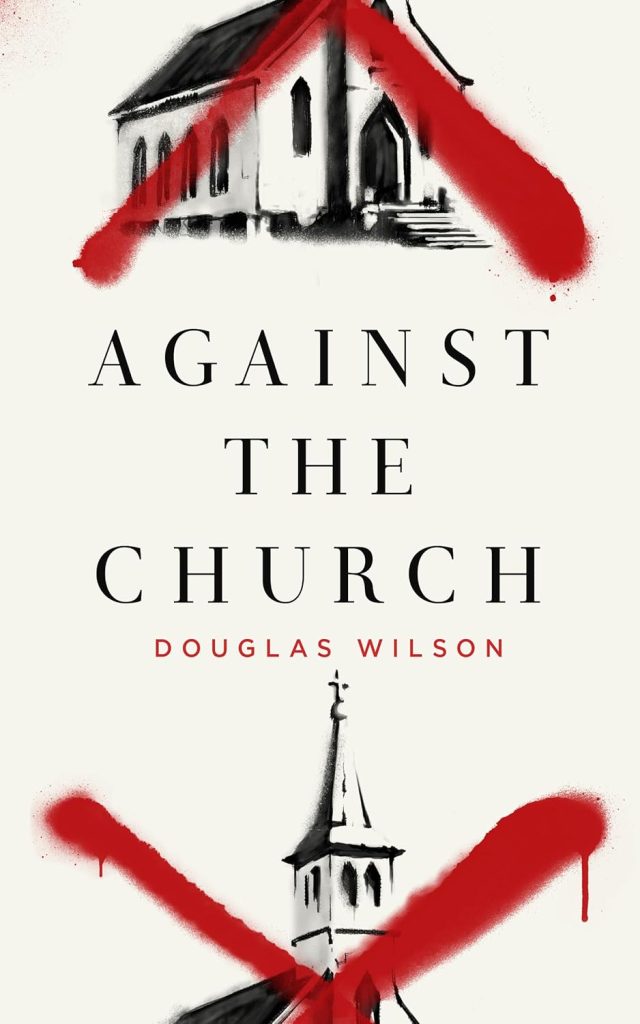
Against the Church, by Dougie Wilson ★★
I received this book as a freebie from Canon Press, and so feel it necessary to manifest charitable respect for the book and its author. I respect Dougie Wilson as an intelligent and wise individual, and in many respects, I stand in agreement with much of what he has to say. Certainly, in this book, he comes across in a very heartfelt and spirited fashion against some of the teaching and practices of standard evangelical churches. Mr. Wilson, who is head pastor of his own church in Moscow, Idaho, rails against evangelical instruction on conversion and regeneration.
Mr. Wilson writes in a fashion that I guess intended to be funny or entertaining? When he does that, he never explicitly comments on how he actually feels. For example in this book, he is for a traditional rendering of regeneration, but then, what is his problem? He comments of the “objectivity” of the covenant, a favorite phrase of his, and yet the phrase is entirely meaningless. Does he also mean that there is a subjectivity of the “covenant”? The reader needs to spend much time in reading and listening to Dougie in order to get his actual point, which will be missed by simply reading one or two of his texts. In writing in a pseudo-amusing style, the reader is constantly challenged to discern what Dougie is actually talking about. Clearly, his writings are something that he feels very strongly about, and Dougie has a fairly large cadre of wonderful people following him in his pursuit of whatever, but putting a finger on Doug’s thoughts can be a veritable challenge.
So, the reader is left in the lurch about what Dougie is actually opposed to with the church, other than when non-Reformed churches stand up against his “hard-lined” Calvinism, or when Reformed churches object to his Federal Vision (FV) theology. I don’t have a serious opinion about Mr. Wilson’s FV theology, because he never ever makes it totally clear was it is, save for his objection to withholding the eucharist from newborn infants. The discipline that I learned in college of comparing and contrasting two opposing views is lost with Mr. Wilson. Mr. Wilson seems to still take personal offense when the Inquisitional heresy hunters of the larger Reformed denominations vigorously attack Dougie as being a heretic. Sadly, writing practically nonsense books such as this one sets Mr. Wilson up for those attacks.
So, I’m left with a predicament in writing this review. Do I write it with the notion that I grasp what Dougie is actually trying to say in his cute and fanciful style, when I am mostly left puzzled as to the entire point of this book? There is much I can agree with, such as his notion that conversion cannot fit into a one-size-fits-all narrative. He stands vigorously for the five solas, save for one problem; every one of the five solas needs clarification. As an example, does sola Scriptura imply that there is no action of the Holy Spirit in conveying truth to us? Does it imply that tradition must be trashed? Does sola gratia imply a sense of fatalism, i.e., it doesn’t matter what we decided since it is God alone who powers our decisions and lives? Does soli deo gloria imply that we cannot give a human honor (glory), such as praising JS Bach, who wrote s.d.g. (soli deo gloria) at the end of each of his compositions?
If I were to sit down with Mr. Wilson over a good cognac and cigar, I believe we would be in agreement with most things. But, in sitting down with him, I would force him to quit using his cute little aphorisms and to speak plainly. So, why can’t Wilson ever write a book that clearly defines his thinking? (He actually has, but those books are rare). Much of the product of Mr. Wilson’s press publications are cute little pieces of rubbish, and this book is one of them. I gave the book two stars instead of one, since I feel that I would probably agree with much of Wilson’s thesis over the cognac and cigar session. I just wish he would be more consistently clear in his thinking when he writes.

