January 2026

Against the Church

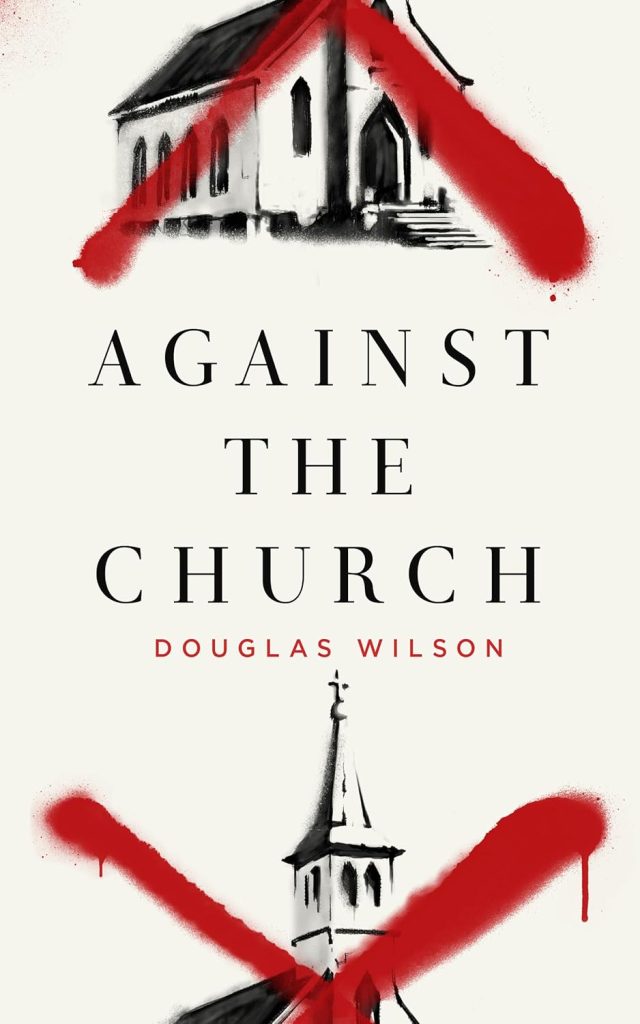
Against the Church, by Dougie Wilson ★★

I received this book as a freebie from Canon Press, and so feel it necessary to manifest charitable respect for the book and its author. I respect Dougie Wilson as an intelligent and wise individual, and in many respects, I stand in agreement with much of what he has to say. Certainly, in this book, he comes across in a very heartfelt and spirited fashion against some of the teaching and practices of standard evangelical churches. Mr. Wilson, who is head pastor of his own church in Moscow, Idaho, rails against evangelical instruction on conversion and regeneration.

Mr. Wilson writes in a fashion that I guess intended to be funny or entertaining? When he does that, he never explicitly comments on how he actually feels. For example in this book, he is for a traditional rendering of regeneration, but then, what is his problem? He comments of the “objectivity” of the covenant, a favorite phrase of his, and yet the phrase is entirely meaningless. Does he also mean that there is a subjectivity of the “covenant”? The reader needs to spend much time in reading and listening to Dougie in order to get his actual point, which will be missed by simply reading one or two of his texts. In writing in a pseudo-amusing style, the reader is constantly challenged to discern what Dougie is actually talking about. Clearly, his writings are something that he feels very strongly about, and Dougie has a fairly large cadre of wonderful people following him in his pursuit of whatever, but putting a finger on Doug’s thoughts can be a veritable challenge.

So, the reader is left in the lurch about what Dougie is actually opposed to with the church, other than when non-Reformed churches stand up against his “hard-lined” Calvinism, or when Reformed churches object to his Federal Vision (FV) theology. I don’t have a serious opinion about Mr. Wilson’s FV theology, because he never ever makes it totally clear was it is, save for his objection to withholding the eucharist from newborn infants. The discipline that I learned in college of comparing and contrasting two opposing views is lost with Mr. Wilson. Mr. Wilson seems to still take personal offense when the Inquisitional heresy hunters of the larger Reformed denominations vigorously attack Dougie as being a heretic. Sadly, writing practically nonsense books such as this one sets Mr. Wilson up for those attacks.

So, I’m left with a predicament in writing this review. Do I write it with the notion that I grasp what Dougie is actually trying to say in his cute and fanciful style, when I am mostly left puzzled as to the entire point of this book? There is much I can agree with, such as his notion that conversion cannot fit into a one-size-fits-all narrative. He stands vigorously for the five solas, save for one problem; every one of the five solas needs clarification. As an example, does sola Scriptura imply that there is no action of the Holy Spirit in conveying truth to us? Does it imply that tradition must be trashed? Does sola gratia imply a sense of fatalism, i.e., it doesn’t matter what we decided since it is God alone who powers our decisions and lives? Does soli deo gloria imply that we cannot give a human honor (glory), such as praising JS Bach, who wrote s.d.g. (soli deo gloria) at the end of each of his compositions?

If I were to sit down with Mr. Wilson over a good cognac and cigar, I believe we would be in agreement with most things. But, in sitting down with him, I would force him to quit using his cute little aphorisms and to speak plainly. So, why can’t Wilson ever write a book that clearly defines his thinking? (He actually has, but those books are rare). Much of the product of Mr. Wilson’s press publications are cute little pieces of rubbish, and this book is one of them. I gave the book two stars instead of one, since I feel that I would probably agree with much of Wilson’s thesis over the cognac and cigar session. I just wish he would be more consistently clear in his thinking when he writes.

The Doctrine of God


The Doctrine of God, by Gerald Bray ★★★★★

This book has been sitting on my shelf for quite a few months, awaiting the time that I had to tackle it. I regret that it took so long, and have found it to be one of the better books that I’ve tackled in the last few years. Written by an Anglican who teaches at Beeson Seminary in Birmingham, Alabama. Bray offers a historical discussion of the development of the doctrine of the Trinity, beginning with Tertullian and Origin, then the definitive work of the three Cappadocian fathers, Augustine, and then later developments, first with the medieval scholastics, with John Calvin honing in on the nature of the trinity. Modern input from scholars such as Moltmann and Barth are also discussed.

Reacting to Origin’s concept of a hierarchy within the trinity, Gregory of Nazianzus offered the concept of perichoresis, a fancy sounding Greek word which in modern ecclesiastical use represents the equality of all three persons in the trinity, sharing their divinity, their will, their holiness, and all three possessing an unfettered love for each other in the Godhead. Controversy emerged with the Cappadocians over the son being “begotten” of the Father, but the Holy Spirit “proceeding” from the Father, a controversy still not fully settled, and still causing the disagreement with the Orthodox churches regarding the insertion of the filioque clause within the Nicene Creed; this is a controversy which remains unsettled. John Calvin argued for the perichoresis within the Trinity, which would necessitate the filioque clause, agreed upon by both Protestants and Roman Catholics, though mystery will always remain concerning the precise nature of the interaction of the persons in the Godhead.

More subtle points were discussed. Modern thinking focuses more on the persons of the Trinity, versus on the essence of the Trinity. Recent discussions try to clarify the meaning of “person” in light of the slightly differing understanding of the Greeks and Romans regarding that word. Recent emphases on promoting one member of the Trinity above the others was discussed, the most contemporary argument relating to the Charismatic promotion of the Holy Spirit, leading to the Father getting the short shaft on thinking.

Bray writes well, and is a delight to read. His insights cause for slow reading. I have brought up various issues in church about the nature of the Trinity and the filioque clause, which were summarily sloughed off, but which Bray answered to my satisfaction. I’m most happy that Bray is willing to proffer that he doesn’t have all the answers, and admits to mystery that we will probably ponder until we achieve glory. This is NOT an easy book to read, and it really helps to have a fundamental knowledge of the patristic saints. I was going to use it as a church book club book, but realized it would overwhelm almost everybody in the group. Thus, I’ll defer to those wishing to explore deeper into the nature of God and let books be used of a more pragmatic, devotional bent to be used instead.

Nicene Post Nicene Fathers Vol 7

Nicene and Post-Nicene Fathers Series 1 Volume 7 ★★★★★

This is the 7th volume of the writings of Augustine, as collected by Schaff, with one more to go. This volume consisted of his sermons on the gospel of John, and sermons on I John. At the end are Augustines’ soliloquies.

The sermons are fascinating reads. They dwell heavily on defending the trinity and divinity of the Son. They are all expository sermons, and short, probably no more than 20 minutes in length, or about 15 pages of text. What I find fascinating is that these are sermons that seem to have been delivered on a daily basis. They are very pastoral, and always exhorting one to holy living. They reflect the mature thought of Augustine, and are excellent examples of a great pastor.

The soliloquies are two writings delivered soon after Augustine became a Christian. They are reflections oriented around epistemology, i.e., what is truth? These writings are not in the mature style of Augustine, and a tad bit tedious to work through, thus were mostly skimmed. Even still, they reflect the nature of how Augustine thinks.

Redeeming the Life of the Mind

Redeeming the Life of the Mind: Essays in Honor of Vern Poythress ★★★

I purchased this book last April off of Amazon, and for the life of me, cannot now determine why I bought the book. I typically don’t read Festschrifts or edited editions that consist of a massive variety of themes and subjects. So, whether somebody else recommended this text to me or what, I simply don’t remember. JI Packer provided the foreword, but did not address any of the contents of the book; his focus was to tell that he met Vern Poythress and thought that he was a nice guy.

There were a total of 20 essays. The few that stood out to me were John Frames’ essay on presuppositionalism and perspectivalism, Wayne Grudem’s argument against “lesser sins” in ethics, and Carl Trueman using the Greek novel of Antigone to show show drastically thinking has changed in the past 20-40 years as compared to all time before that.

Many (but not all) of the remaining essays were academicians (or post-academicians), all of whom had academic contact with Poythress, writing pseudo-intellectual essays in defense of their theological theme. Sadly, that’s a trait of all of academia; it’s just a pity that conservative theological ivory towers has to follow suit.

I do not recommend this book, unless one has had a personal interaction with Dr. Poythress. The few excellent essays do not justify the purchase of this text.